The Data Moat in Food Innovation
Why we built FlavorWiki GPI - and why AI makes real-world product experience data more valuable, not less
Authored by Daniel Protz
Founder & CEO, FlavorWiki GPI
Executive Summary
Food and beverage companies are investing aggressively in AI, but the central question is being framed incorrectly. The question is not whether AI will change product innovation. It will. The real question is whether the AI will be grounded in the data required to make product decisions with confidence.
General-purpose AI can summarize trends, synthesize research, draft concepts, and accelerate analysis. But it cannot reliably predict whether a specific product will win with a specific consumer, in a specific market, at a specific price, in a real consumption context unless the underlying product experience has been measured. Food innovation is not a language problem. It is an experience problem.
For top food, beverage, and CPG manufacturers, this creates a strategic inflection point. The value of AI will not come from access to the same public models everyone else can use. It will come from connecting AI to the real-world, first-party product experience data that only each company can generate: sensory perception, liking, purchase intent, value perception, shopper behavior, formulation deltas, contextual evidence, and market-specific benchmarks.
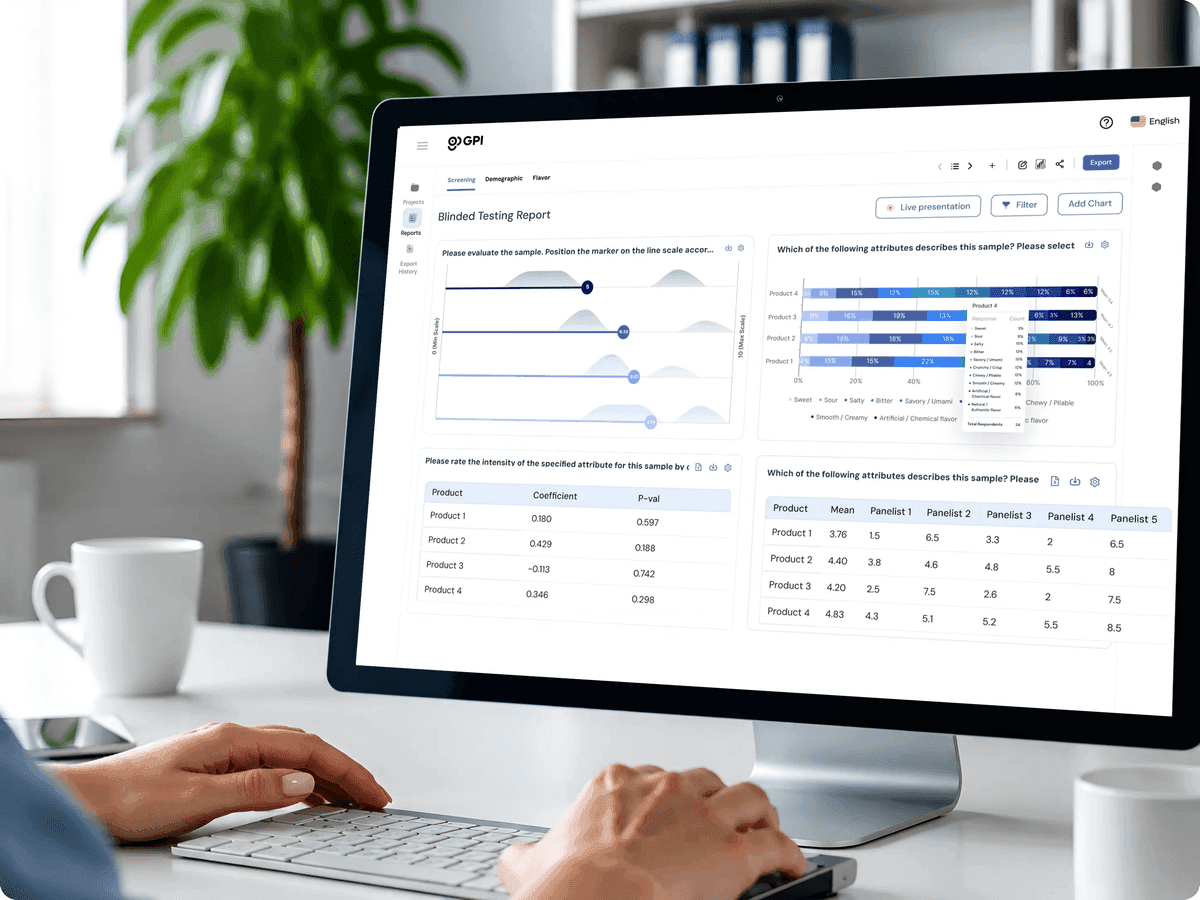
Key takeaways
- The old research model turns valuable studies into static files. GPI turns repeated testing into a connected, reusable system of product intelligence.
- AI trained only on public data sees patterns, not causes. Product decisions require understanding what happens when a formulation, claim, package, price, or context changes.
- The data moat is built by collecting real experiences, enriching them into a common data currency, and applying predictive intelligence to support faster, more confident decisions.
- FlavorWiki GPI was built to move organizations from one-off project learning to compounding product experience intelligence across categories, markets, and reformulation cycles.
The most important strategic shift is this: product research should no longer be treated as a disposable report. It should be treated as an asset that compounds. Every test should make the next decision smarter.
Why We Built GPI
“Food companies do not have a shortage of data. They have a shortage of connected, decision-ready intelligence.”
Daniel Protz, Founder & CEO, FlavorWiki GPI
About five years ago, I started seeing the same pattern across food and consumer-goods companies around the world. Teams were doing serious work. They were running blind taste tests, concept tests, in-home usage tests, sensory panels, shopper studies, claims tests, and market benchmarks. But too often, each study lived alone.
The data sat in disconnected folders. The sensory learning was hard to compare with consumer learning. The shopper context did not connect to product performance. Regional studies used different taxonomies, different scales, and different assumptions. Three months later, the same organization would come back with a similar question – and the team would effectively start from scratch.
We were not building knowledge. We were renting it.
That realization is the background story behind FlavorWiki GPI. FlavorWiki began with a simple mission: capture how real consumers experience products in real consumption moments. Over time, through projects in more than 50 countries, thousands of product evaluations, and millions of product-experience data points, we saw an opportunity to do more than deliver better research projects. We saw an opportunity to help companies build a permanent product intelligence system.
GPI is that next step. It is the evolution from isolated studies to connected product experience intelligence. It combines real-world data collection, sensory science, first-party consumer communities, data governance, and AI-enabled workflows to help teams see what they already know, identify what they still need to learn, and predict where product decisions are likely to perform before full-scale commitment.
The purpose of this whitepaper is to explain why we built it, why the timing matters, and why the companies that win the next era of food innovation will not be the ones with the biggest generic AI model. They will be the ones with the best proprietary product experience data.
Innovation Is Under Pressure
The food and beverage innovation brief has become harder. NielsenIQ reported that Western Europe closed 2025 with FMCG value growth of 3.4%, while innovation sales declined in both value and units, signaling a disconnect between what manufacturers launch and what shoppers choose. [1]
Consumers are also asking brands to solve for competing priorities at the same time. IFIC reported that taste remains the most impactful driver of food and beverage purchase decisions at 85%, with price second at 76%, followed by healthfulness and convenience. [2] That creates a product brief with natural tension: better taste, sharper value, stronger health cues, greater transparency, cleaner labels, local relevance, and less compromise – all at once.
Regulatory pressure adds another layer. The FDA has revoked authorization for FD&C Red No. 3 in food and ingested drugs, with food manufacturers required to reformulate by January 2027. The FDA has also proposed front-of-package nutrition labeling that would interpret saturated fat, sodium, and added sugar as Low, Med, or High. [3][4]
In the UK, the Soft Drinks Industry Levy has already driven a 46% average reduction in sugar in in-scope soft drinks, and the government has continued reviewing ways to strengthen the levy. [5] Reformulation is no longer a special project. It is becoming a permanent operating requirement.
The new innovation reality
Food companies are being asked to move faster and with more confidence, while navigating taste, price, health, trust, sustainability, regulation, and local market fit at the same time. Speed without confidence creates risk. Confidence without speed creates missed opportunities.
When hype outruns experience
Plant-based meat illustrates the cost of misreading innovation signals. GFI reported that 53% of Americans had eaten plant-based meat at some point and 40% had eaten it in the past year, yet 13% were lapsed consumers who had tried it previously but not in the past year. [6] The same report points to taste, texture, and price as critical barriers: people who view plant-based meat as tasty are more likely to purchase and eat it, and lapsed users may be won back as products become tastier and cheaper. [6] The lesson is not that the trend was wrong. It is that trend interest does not automatically become loyalty. Trial is not repeat. A claim is not a consumption experience. A product promise must survive the real moment of use.
What Broke: The Fragmented Research Model
The traditional research stack was not designed for the speed, complexity, or global nature of today’s product innovation. It was designed around projects, not decisions.
In many organizations, the product development ecosystem still looks like this:
- R&D runs formulation and sensory work in one system.
- Consumer insights commissions a separate concept or IHUT study.
- Marketing tests claims, packaging, and messaging through another partner.
- Sales and shopper teams assess shelf, price, promotion, and competitive context separately.
- Regional teams repeat similar work with different methodologies and taxonomies.
Each project may be valid on its own. The problem is that the learning does not compound. Data becomes trapped inside individual reports. Comparisons across studies are difficult. Context gets stripped from decisions. Valuable questions are answered repeatedly, but the organization does not build a reusable intelligence layer.
| Legacy research model | GPI product intelligence model |
|---|---|
| Project files | Connected product experience data |
| Static reports | Searchable, reusable, governed learning |
| Different scales and taxonomies by study | Common data currency across products, markets, and methodologies |
| Insights recreated repeatedly | Cumulative intelligence that compounds over time |
| AI summarizes isolated outputs | AI queries, compares, models, and predicts from connected evidence |
The business cost of fragmentation is not merely inefficiency. It is a decision risk. When sensory, consumer, shopper, price, packaging, and competitive context are separated, teams struggle to explain why a product underperformed. Was it true sensory rejection? An expectation gap created by packaging? Weak in-store visibility? Poor price-value perception? A market-fit issue? A competitive benchmark problem?
A 360-degree product experience approach is needed because purchase and repeat behavior are shaped by the whole experience – not by taste alone, not by packaging alone, and not by concept interest alone.
Why General-Purpose AI Is Not Enough
AI is becoming essential to modern innovation. It can accelerate synthesis, reduce manual analysis, make historical learning easier to query, identify patterns, and help teams generate hypotheses. The mistake is assuming that a general-purpose model trained on public data can replace real-world data generation. General-purpose LLMs are trained primarily to learn statistical patterns in language. That makes them excellent at summarizing what has been said, written, reviewed, or published. But CPG product innovation asks a different class of question: What will happen if we change something? Those are causal questions: What happens if we reduce sugar by 10%? Which sensory attribute is driving preference or rejection? Would this product travel from one market to another without full retesting? Will a new claim increase trial without damaging trust? Which consumers are we likely to lose if we reformulate to remove an ingredient?
Judea Pearl’s causal framework distinguishes between association, intervention, and counterfactual reasoning. Association observes patterns; intervention estimates what happens when an action changes the system; counterfactual reasoning asks what would have happened under a different decision. [7] General-purpose AI operates most naturally at the level of association. Product innovation requires intervention and counterfactual reasoning.
| AI can help... | AI cannot replace... |
|---|---|
| Retrieve similar studies | The act of measuring a new product experience |
| Summarize open-ended feedback | A controlled formulation comparison |
| Identify patterns across connected data | A real consumer tasting, using, shopping, or reacting in context |
| Generate hypotheses | The evidence needed to validate which hypothesis matters |
| Translate data into usable narratives | The proprietary data that makes those narratives true |
The core AI principle for CPG
AI does not create product truth from public text. It magnifies the value of measured product experience. The better the data foundation, the more valuable the AI layer becomes.
Public data is especially limited in food, beverage, and CPG because it over-represents launched products, visible winners, marketing narratives, reviews, and post-hoc explanations. It rarely includes failed concepts, controlled formulation deltas, blind-vs-branded comparisons, market-specific sensory benchmarks, or the context of use that drives repeat purchase. Public data can tell you what people talked about. It cannot tell you what your target consumer will taste, feel, value, reject, or repurchase in the moment that matters. This is why leading perspectives on AI in CPG increasingly emphasize AI as an accelerator when paired with strong consumer insight, earlier testing, faster decision-making, and leadership commitment – not as a substitute for the fundamentals of innovation. [8]
The Data Only You Can Create
The strongest competitive advantage in product innovation is not access to an algorithm. Algorithms are becoming more accessible. The durable advantage is proprietary data that competitors cannot scrape, buy, or infer from public sources.
In food and beverage, the most valuable data is product experience data: how people perceive, evaluate, choose, consume, and talk about a product in context. It includes sensory perception, emotional reaction, preparation behavior, packaging expectation, value judgment, shopping evidence, competitive comparison, and repeat likelihood.
This data becomes a moat when it has four characteristics:
- It is first-party: created from your products, consumers, markets, and decisions.
- It is structured: normalized so it can be compared across studies, products, markets, and time.
- It is contextual: linked to sensory, behavioral, attitudinal, shopper, and market signals.
- It is cumulative: each new study strengthens the intelligence system rather than disappearing into a report.
This is the shift from research as an expense to product data as an asset. A single test can answer one question. A connected, governed data foundation can improve every future question.
Product Experience Intelligence defined
Product Experience Intelligence is the governed system for collecting, standardizing, connecting, enriching, and modeling real-world product experience data so teams can make faster, smarter product decisions across the product life cycle.
This is also why FlavorWiki GPI is positioned as an end-to-end, AI-driven product experience platform for collecting, enriching, and transforming first-party data into predictive insights. GPI is built on the foundation of FlavorWiki and designed to transform disconnected research into connected, compounding product intelligence. [9]
The GPI Operating Model: Collect, Enrich, Predict
The GPI model is intentionally simple: collect, enrich, predict. The simplicity matters because large organizations do not need another research tool; they need a repeatable operating model for product decisions.
| Layer | What it does | Why it matters |
|---|---|---|
| 1. Collect | Capture real-world product experience data: IHUT, sensory, shopper journey, concepts, consumer videos, product attributes, packaging, pricing, and competitive context. | Grounds decisions in real consumer evidence from in-home, in-store, on-the-go, and other relevant consumption contexts. |
| 2. Enrich | Standardize and structure learning; connect sensory, hedonic, behavioral, attitudinal, product, and market signals; create relationships across studies. | Turns fragmented studies into a common data currency that can be searched, compared, reused, and governed over time. |
| 3. Predict | Apply AI, modeling, and statistical analysis to identify recurring patterns, optimization opportunities, confidence gaps, and testable hypotheses. | Supports faster go/no-go decisions, reformulation pathways, market readiness indicators, and targeted validation. |
Collect without enrichment creates another silo. Enrichment without prediction creates a cleaner archive. Prediction without real-world collection creates false confidence. The value is in connecting all three.
GPI is built to create a common data currency that compounds over time. That currency allows teams to ask always-on questions such as:
- Which reformulations performed well in Europe, and why?
- Which sensory attributes most influence repeat purchase?
- What markets may tolerate lower sweetness or different texture?
- Which products show high satisfaction but low repeat intent?
- How does our product compare to category leaders on taste, value, and shelf context?
- Where do we need additional data before we scale?
From a study you forget to a system that compounds
The phrase “common data currency” is important. Food companies already have data. What they often lack is a way to make data comparable. A sensory study in France, an IHUT in Mexico, a package test in the U.S., and a category benchmark in the UK can all be valuable. But they only become enterprise intelligence when they are structured in a way that can be searched, related, modeled, and reused.
This is where AI becomes significantly more powerful. Instead of asking AI to invent insight from public averages, teams can ask AI to retrieve similar studies, synthesize historical learning, compare markets, surface anomalies, identify likely drivers, and recommend where new testing will add the most confidence.
Built on FlavorWiki strengths
The GPI model builds on FlavorWiki’s existing strengths in global community access, detailed recruitment, end-to-end logistics and sampling, agile fieldwork, data management, patented paired-question methodology, research analytics, and data science. GPI’s public positioning emphasizes first-party access to a proprietary global community of more than 2 million consumers, in-context testing in store, in home, or on the go, patented Paired Question capabilities that link product profiling to lab work, AI-enabled workflows for expert researchers, and scalable data combination across 50+ countries. [9] This matters because product experience intelligence cannot be built from dashboards alone. It requires high-quality data generation and governance at the source.
What Product Experience Intelligence Unlocks
Product Experience Intelligence changes the decision conversation. It moves teams from retrospective reporting to forward-looking decision support. It helps leaders decide when to launch, when to reformulate, when to localize, when to validate, and when to stop.
1. Better-evidenced go/no-go decisions
A go/no-go decision is only as good as the comparison set behind it. When historical benchmarks and live test data are connected, teams can assess whether a product is meaningfully different from prior winners, similar to known failures, or simply missing evidence in a critical segment or market.
2. De-risked reformulation
Reformulation is now driven by cost, regulation, nutrition, sustainability, ingredient availability, and changing consumer expectations. GPI supports reformulation by linking formulation changes to sensory perception, liking, purchase intent, value perception, and local taste expectations. The goal is not to test everything everywhere. The goal is to know where confidence is high, where risk is concentrated, and where targeted data collection is required.
3. Market transferability
Global brands face a recurring challenge: full validation in every market is often too slow and expensive, but local teams need confidence that a product will perform in their market. A connected intelligence system can combine anchor-market data, sensory profiles, historical benchmarks, and targeted first-party market dips to estimate likely performance and identify confidence gaps.
4. Repeat likelihood and launch survival
CPG success depends on repeat behavior, not trial alone. A concept that wins curiosity can still fail at repeat if the product experience does not deliver. By connecting sensory diagnostics, consumer liking, purchase intent, open-ended feedback, value perception, and context, GPI helps teams identify the signals that separate a product consumers try from a product consumers buy again.
5. Shopper and 360-degree context
Blind tests are useful, but incomplete. Real purchase decisions include brand, packaging, price, claims, shelf context, findability, messaging, and competitive alternatives. GPI’s 360-degree approach is designed to disentangle whether underperformance is driven by true sensory shortcomings, expectation gaps created by packaging or claims, value perception versus competitors, or in-store execution and visibility.
Same product. Different context. Different decisions.
An anonymized FlavorWiki beverage benchmark showed how products that appeared similar in blind central-location testing separated more clearly when evaluated in branded, in-context home-use conditions. The point is not that blind testing is wrong. It is that blind testing is incomplete when the business decision is a real market launch.
How to Start: From One Project to Compounding Knowledge
Organizations do not need to transform every research workflow at once. The practical path is to start with one decision, structure the data correctly, and build from there.
| Step | Action | Business outcome |
|---|---|---|
| Prepare | Inventory existing product, sensory, consumer, and market data. Identify duplicated studies, inconsistent taxonomies, and data that is not reusable. | Creates visibility into what the organization already knows and where learning is trapped. |
| Pilot | Choose one live decision - go/no-go, reformulation, market transfer, shopper context, or repeat prediction - and run a hybrid study tied to that decision. | Proves value on a real business question rather than an abstract research exercise. |
| Normalize | Define shared product experience variables, sensory descriptors, consumer segments, and outcome metrics. | Turns project data into comparable data. |
| Model | Use JAR diagnostics, sensory descriptors, hedonic data, purchase intent, value perception, and context to generate predicted liking or market readiness with confidence ranges. | Moves from reporting to predictive decision support. |
| Decide | Act on strong signals. Use moderate signals to trigger targeted incremental data collection. Stop or redesign where evidence is weak. | Improves speed while protecting decision quality. |
The key is discipline. Every new project should be designed not only to answer today’s question, but also to enrich tomorrow’s knowledge base. That means common variables, consistent metadata, connected outcomes, and governance from the beginning. Over time, the organization moves from project ROI to intelligence ROI. Each study becomes more valuable because it contributes to a larger system. AI then helps retrieve, synthesize, model, and operationalize that system across functions.
Conclusion: The Model Is Not the Moat
AI will change product innovation. But it will not eliminate the need to understand real consumers in real product moments. The winners will be the companies that use AI to multiply the value of evidence, not replace it with averages.
For food, beverage, and CPG leaders, the strategic implication is clear: proprietary product experience data is now an enterprise asset. It should be collected deliberately, enriched continuously, and modeled intelligently. It should not be allowed to disappear into isolated project files. The next era of product innovation will belong to organizations that can answer not just “What happened?” but “Why did it happen?”, “What will happen if we change it?”, and “How confident are we before we scale?”
That is why we built FlavorWiki GPI. To help brands move from fragmented testing to predictive product intelligence. To turn real-world consumer experience into a common data currency. To make faster, smarter product decisions possible. And to ensure that AI is grounded in the data that matters most: the data only you can create.
Final thought
AI does not replace data generation in CPG. It magnifies its value. The competitive moat is not the model. It is the data that only you can create.
About FlavorWiki GPI
FlavorWiki GPI is a product experience intelligence platform built to help food, beverage, and consumer brands collect, enrich, and predict product performance using real-world consumer, sensory, and market data. Powered by FlavorWiki’s global research foundation, proprietary product experience data, sensory science capabilities, and AI-enabled workflows, GPI helps R&D, insights, sensory, marketing, and innovation teams make faster, more confident product decisions.
GPI brings together in-context product testing, advanced sensory diagnostics, first-party global consumer access, AI-enabled synthesis, data normalization, and predictive modeling. It is designed to help organizations move from one-off project learning to a reusable intelligence system across products, categories, markets, and reformulation cycles.
About the Author
Daniel Protz is the Founder and CEO of FlavorWiki GPI. He built FlavorWiki to help food and consumer-goods companies capture real-world product experience at scale and translate consumer feedback into actionable innovation intelligence. GPI is the next evolution of that mission: a connected product experience intelligence platform designed for faster, smarter product decisions.
References
- [1]NielsenIQ. "Innovation under pressure." January 28, 2026. https://nielseniq.com/global/en/insights/analysis/2026/innovation-under-pressure/
- [2]International Food Information Council. "2024 IFIC Food & Health Survey." June 2024. https://ific.org/
- [3]U.S. Food and Drug Administration. "FDA to Revoke Authorization for the Use of Red No. 3 in Food and Ingested Drugs." January 15, 2025. https://www.fda.gov/
- [4]U.S. Food and Drug Administration. "Front-of-Package Nutrition Labeling." Updated May 2025. https://www.fda.gov/
- [5]HM Treasury, HM Revenue & Customs, and Department of Health & Social Care. "Strengthening the Soft Drinks Industry Levy consultation." Updated November 25, 2025. https://www.gov.uk/
- [6]The Good Food Institute. "Consumer snapshot: Plant-based meat in the US." 2024. https://gfi.org/
- [7]Pearl, Judea, and Dana Mackenzie. The Book of Why: The New Science of Cause and Effect. Basic Books, 2018.
- [8]McKinsey & Company. "State of Food and Beverage: The choices CPG leaders can make to renew growth." April 8, 2026. https://www.mckinsey.com/
- [9]GPI - Global Product Insights. "Product Experience Intelligence for Global Brands." Accessed June 2026. https://gpiexperience.com/
- [10]Jordan, Michael I. "Artificial Intelligence - The Revolution Hasn't Happened Yet." Harvard Data Science Review, 2019.
- [11]FlavorWiki GPI. Internal anonymized beverage benchmark and Food Innovate Summit presentation, 2026.