Predicting Product Success Through Better Decisions
Posted Date :
A recipe change can meet its cost or nutrition target and still weaken the reason consumers buy the product. The risk returns with every sugar, salt or fat reduction, color replacement and move toward a cleaner label. Across a large food and beverage portfolio, that makes reformulation a recurring risk of losing consumers.
The commercial question reaches beyond whether the revised product passes a test. Which aspects of the experience must remain intact? Which changes could improve acceptance? And where could a small saving create a larger loss in preference or repeat purchase?
For consumer insights, sensory and R&D leaders, answering those questions requires evidence that connects the formulation to the consumer response. It also requires retaining that evidence so the next change starts from what the business already knows.
How the innovation journey becomes an R&D decision
In our recent Food Innovate Webinar Predict Better. Innovate Faster we mapped the innovation journey from concept and claims to prototypes, sensory and consumer evaluation, local market adaptation, launch and subsequent learning. Each stage answers a different question. A concept establishes relevance; a prototype tests whether the experience can deliver it; market validation examines whether that experience works for the intended audience and occasion.
Renovation adds an existing product and its buyers to that equation. A new product may need to beat a competitor or establish a distinctive benefit. A reformulation must meet its new brief while protecting the qualities that current buyers value. The decision criteria should therefore be agreed before testing: the required improvement, the experience to preserve and the evidence needed to proceed.
Across markets and functions, the difficulty is carrying those criteria and the supporting data from one stage to the next. Separate studies become more useful when teams can compare the same product versions, consumer groups and outcomes.
The evidence behind a formulation decision
A useful decision brings several kinds of evidence together. Each answering a specific part of the brief.
- Product and formulation data. Without a reliable link between a sample and its formulation, a promising result is difficult to reproduce.
- Sensory measurements. Descriptive profiling measures how attributes differ. Temporal methods show how sensations develop during consumption. Discrimination tests assess whether a difference is detectable. Detectability alone does not establish whether consumers prefer or reject the change.
- Consumer response. Connect those measurements to liking, purchase intent, perceived value and consumers’ explanations. Examine loyal buyers and wider category users separately where the decision calls for it. An acceptable average can conceal a problem among the buyers a renovation needs to retain.
- Market and usage context. Include relevant competitors, price, packaging, claims and consumption occasions. Controlled sensory work helps diagnose the product; branded and in-home research tests how it performs within the wider experience.
Connected Analysis can change where teams direct effort
The analysis should produce a prioritized development brief: which attribute to investigate, the direction and range of change to test, the audience it matters to, and the uncertainty still requiring validation.
R&D then translates those sensory targets into feasible formulation trials.
- Identify the attributes worth improving. In a study of 75 sweet-snack products, sensory measures including sweetness, dissolvability, crunch duration and moisture helped explain consumer scores. Health and wellbeing perceptions added no predictive power in that analysis. The finding directed attention toward the eating experience; it did not establish that health positioning is irrelevant in every category.
- Locate the source of the problem. In a chip example spanning three markets, a model focused on base-product attributes performed better than the broader model including seasoning. The analysis pointed renovation toward the base recipe, helping the team question whether separate seasoning changes were the right investment.
- Avoid changing the wrong things. An eight-product salty-snack analysis found different patterns for loyal fans and everyday category buyers. It also classified eight of eleven apparent just-about-right problems as false reformulation alarms. The practical lesson is to check which complaints are associated with weaker performance before turning them into development priorities.
FlavorWiki GPI Predictive Analytics unlocked the specific findings hidden in the data collected and analyzed.
Where GPI Sensory supports the process
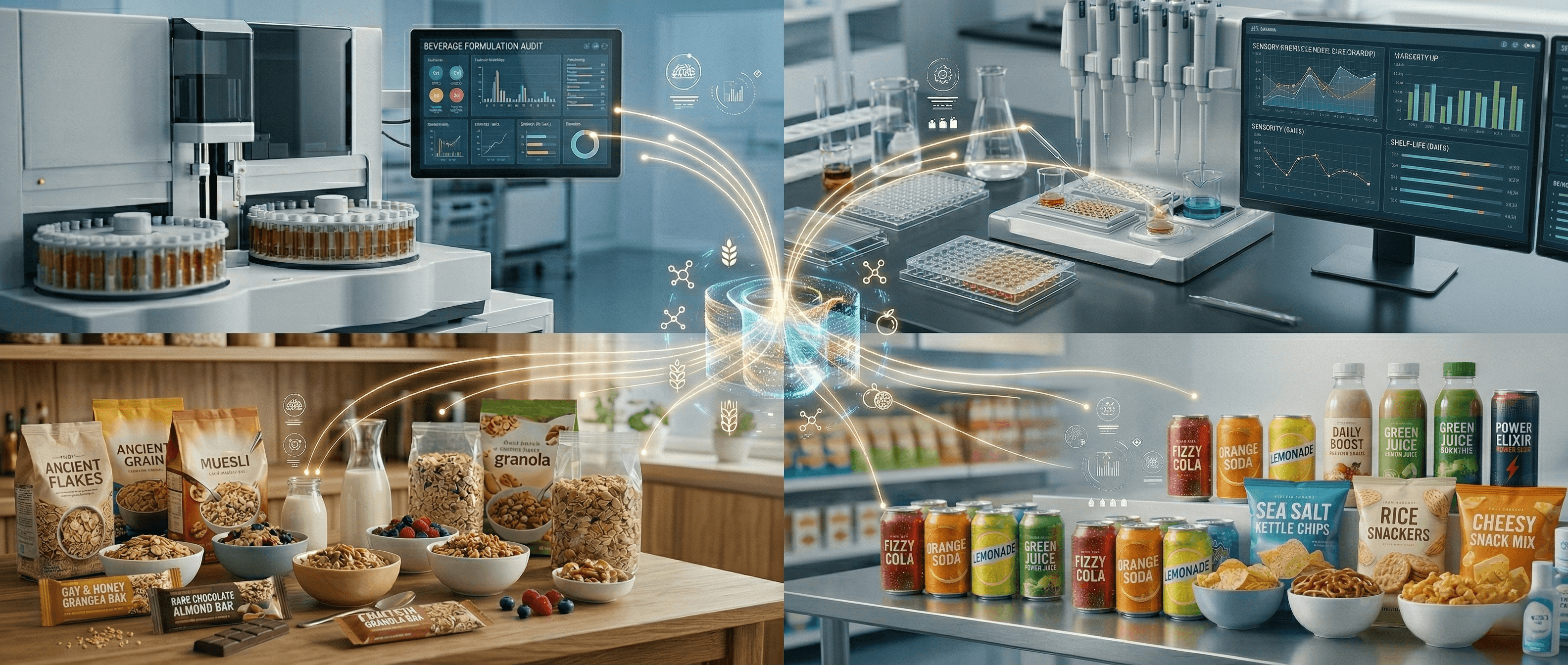
GPI Sensory gives teams a working environment for the laboratory evidence behind these decisions. Descriptive, temporal and discrimination methods help characterize product changes, while built-in statistics and live reporting support comparisons and follow-up analysis. Segmentation helps researchers examine whether a result holds across the audiences that matter.
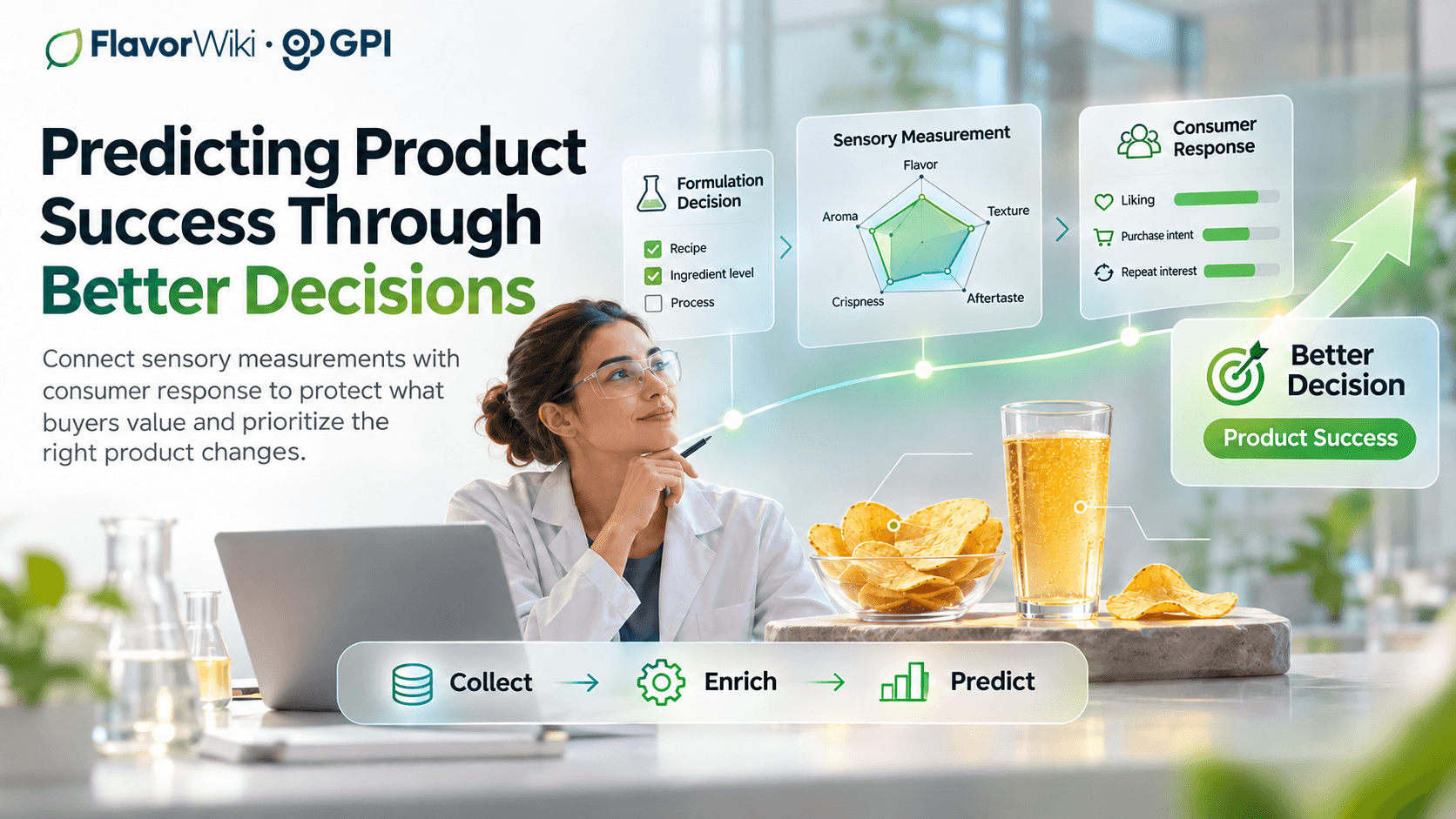
Within the broader FlavorWiki GPI approach, that laboratory evidence can be connected with current and historical consumer research, product information and market benchmarks. The operating model is Collect, Enrich, Predict: gather the relevant evidence, organize it for comparison, then use analysis and modeling to narrow the next decision.
What this means for a recurring renovation program
The team first reviews previous versions and relevant consumer learning, then compares the existing recipe with candidate formulations. Sensory work identifies changes in sweetness, mouthfeel and aftertaste. Consumer testing establishes whether those changes affect liking, value or purchase intent, particularly among existing buyers. Modeling can help prioritize the combinations worth taking into the next trial.
For leadership, this creates a clearer basis for weighing ingredient savings against acceptance risk, comparing candidate investments and deciding where additional research is worth funding. It also preserves what the team learned when another change becomes necessary.
Start with one live product decision
The value of the GPI Sensory launch lies in helping teams connect precise product measurement to those decisions. Over successive projects, FlavorWiki GPI can help build a clearer understanding of which changes improve the experience, which put it at risk and which deserve no further investment.
Explore GPI Sensory or talk with our team about a current innovation or reformulation decision.
For the broader perspective, read our whitepaper The Data Moat in Food Innovation.
Hero Asset Copy and Focus Areas
Companion content for the GPI Sensory launch
Headline Know what to change before you change the recipe
Supporting copy Connect sensory measurements with consumer response to prioritize improvements, protect what buyers value and build evidence for the next product decision.
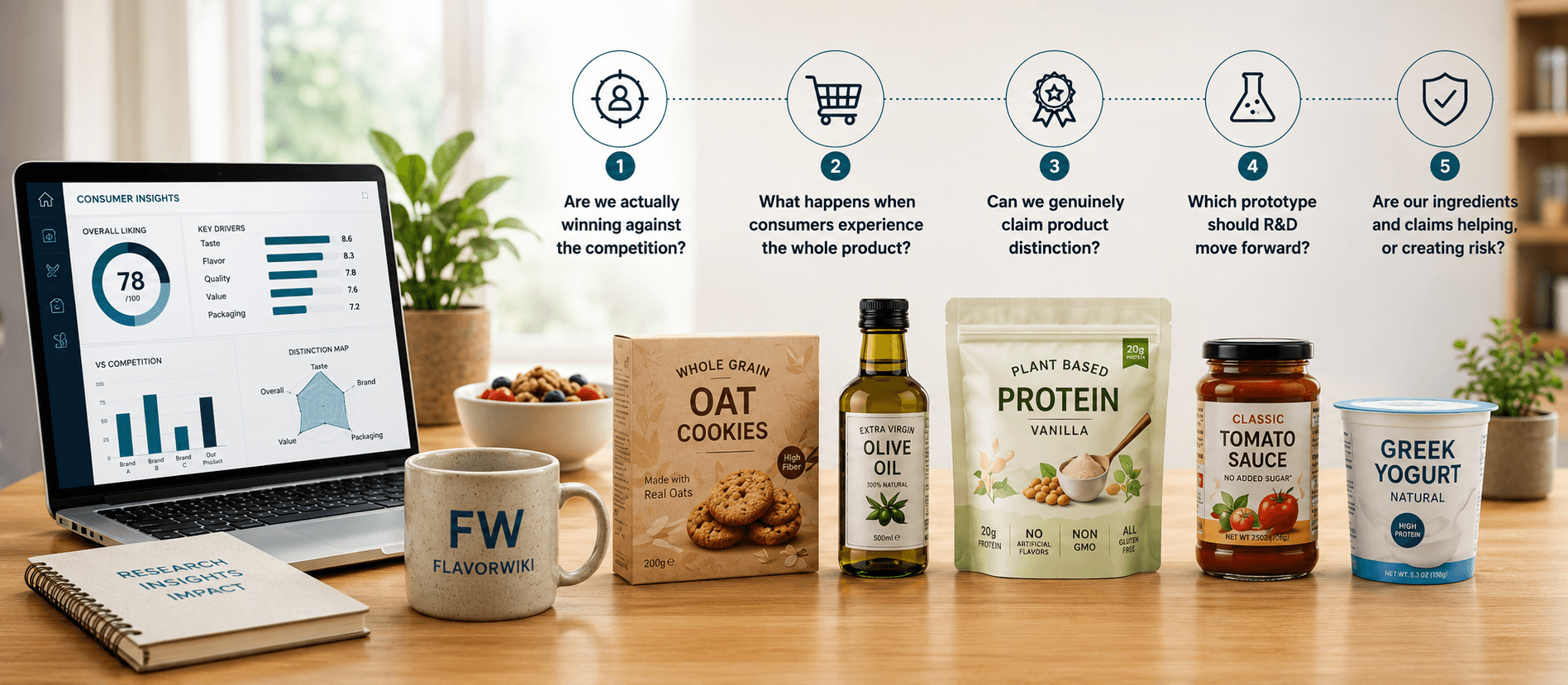
Use these five decision areas to replace a feature-led capabilities overview. GPI Sensory supplies the laboratory and analysis tools; the broader FlavorWiki GPI platform and research support connect them to consumer and market decisions.
Focus area
- Protect the experience
- Prioritize the right changes
- Understand who is affected
- Validate in the right context
- Reuse what the business learns
Decision for leaders
- Which qualities must a reformulation preserve?
- Where should R&D focus its next trial?
- Could an average result hide risk to current buyers?
- Does the revised product work in the intended market?
- How does this study improve the next decision?
Supporting capabilities
- Descriptive and temporal methods; discrimination testing; comparison with the current product.
- Consumer and sensory modeling; JAR penalty analysis; competitive benchmarks.
- Cross-tabs and segmentation; loyal-buyer and category-user comparisons.
- In-home and in-context research; claims, packaging, price and competitor evaluation.
- Current and historical data; consistent product and attribute definitions; governed access.
CTA Bring us your next product change
Editorial source notes
Blog sources: Food Innovate webinar deck, slides 7–10 and 13–23; expanded webinar abstract; FlavorWiki Intro & Sensory deck, slides 3–6, 10–22 and 25–33; The Data Moat in Food Innovation; current GPI Sensory website.
The three examples are anonymized findings from the supplied webinar material. No client names, cost savings or launch-success rates have been inferred. The sugar-reduction workflow is explicitly illustrative.
Numeric model-performance headlines were omitted because model fit and validated predictive accuracy are different measures. The webinar identifies R² = 0.89 within flavor groups in one case; that is not an 89% probability of product success.